

TABLE OF CONTENTS
Water Fed Pole vs Traditional Window Cleaning: Which Is Better?
If you have seen a window cleaner standing on the pavement with a long pole and a hose, you have seen water fed pole cleaning. It has become the most common way to clean the outside of homes in the UK, but traditional squeegee cleaning still has its place. So which is better for your windows?
This guide explains how both methods work, what each one does well and where each one falls short, so you can decide what suits your property. You can also see how we use the water fed pole system on our window cleaning in London page.
How traditional window cleaning works
Traditional window cleaning uses a bucket of water mixed with a small amount of detergent. The cleaner wets the glass with an applicator, then removes the water with a squeegee and dries the edges with a cloth or scrim. For upper floors, the cleaner either uses a ladder or works from inside the building.
Advantages of traditional cleaning
- Very good results on glass that can be reached easily.
- Ideal for inside windows, glass partitions and mirrors.
- No special water supply needed.
Disadvantages of traditional cleaning
- Ladders are needed for upper floors, which adds risk and can damage lawns, flower beds and gutters.
- Frames and sills are often only wiped, not fully washed.
- Detergent residue can be left behind, which attracts dirt and shows rain spots.
How water fed pole cleaning works
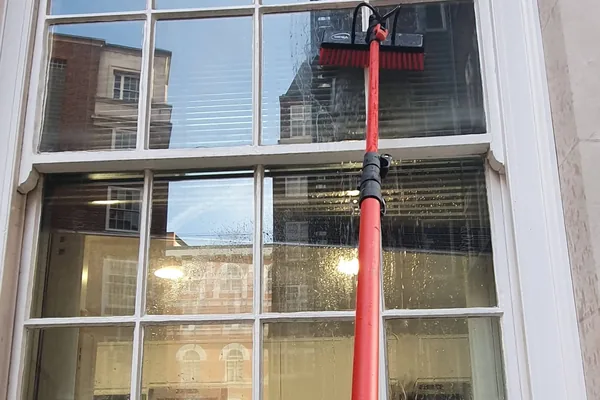
A water fed pole system uses tap water that has been purified, usually by reverse osmosis and deionisation. This removes the minerals that normally leave spots when water dries. The purified water is pumped up a lightweight, extendable pole to a soft brush.
The cleaner scrubs the glass, frames and sills with the brush, then rinses everything with pure water. Because there are no minerals or soap in the water, the glass dries clear without being squeegeed.
Advantages of water fed pole cleaning
- Upper windows can be cleaned from the ground, usually up to the second or third floor, with no ladders against the walls.
- Frames and sills are washed and rinsed at the same time as the glass.
- No chemicals are used, which is better for plants, pets and the environment.
- No soap residue, so windows tend to stay cleaner for longer.
- Hard-to-reach glass, such as conservatory roofs, skylights and windows above extensions, can often be reached.
Disadvantages of water fed pole cleaning
- It is designed for outside windows, not inside.
- Heavy deposits such as paint, cement or old stickers need extra treatment.
- Glass may look wet for a short time after cleaning while it dries.
- Very high buildings may still need specialist access.
Is pure water really enough to clean windows?
Many people are surprised that windows can be cleaned without soap. Pure water is very good at dissolving dirt because it has had its minerals removed. Together with the scrubbing action of the brush, it removes the everyday grime, dust and traffic film that builds up on London windows. Once the glass dries, there is nothing left behind to attract dirt.
For stubborn marks such as bird droppings or sap, the cleaner will usually spend extra time scrubbing the area. Paint splashes, cement and adhesive are different and need specialist care; our guide on how to get paint off windows explains what to try and what to avoid.
Which method is safer?
Falls from ladders are one of the main causes of serious accidents at work in the UK. Water fed pole systems let the cleaner work with both feet on the ground, which is why many companies prefer them for first and second floor windows. It also means no ladders leaning on your gutters or standing in your flower beds.
Which method is better for different properties?
Terraced and semi-detached houses
Water fed poles are usually the best choice for the outside. They reach the upper floor from the street or garden and clean frames and sills at the same time.
Period homes with sash windows
Tall sash windows in areas like Islington and Chelsea are well suited to water fed poles on the outside. Inside cleaning is best done by hand.
Conservatories
Water fed poles can clean conservatory sides and many roofs without anyone standing on the structure, which should always be avoided.
Shops and offices
Both methods work well. Many shops use pure water for the outside and traditional cleaning for inside glass and doors.
The best of both
For most homes, the ideal combination is a regular water fed pole clean for the outside and an occasional hand clean for the inside. That way, the outside stays clean throughout the year and the inside gets a thorough polish a few times a year.
Frequently asked questions
Why are my windows wet after a water fed pole clean?
The glass is left to dry naturally. Because the water is pure, it dries without leaving spots.
Can a water fed pole clean in the rain?
Light rain does not usually affect the result, because there is no soap residue for the rain to mark. Heavy rain or strong wind may mean rescheduling.
How high can a water fed pole reach?
Most residential poles reach second and third floor windows. The exact height depends on the pole, the access and the ground conditions.
Is water fed pole cleaning more expensive?
Not usually. Because it is efficient, prices for regular rounds are often similar to or lower than traditional cleaning.
Want to try pure water window cleaning?
We clean windows with water fed poles across south east London and beyond, including Catford, Lewisham, Bromley and Greenwich. Send us your address for a quote.