

TABLE OF CONTENTS
A rug takes more punishment than most fitted carpets. It sits where people walk, eat and play, it gets kicked out of place and it often lives in front of the sofa or under the dining table. Yet many rugs are made of fibres that do not like water at all, so the cleaning method that works on a fitted carpet can ruin a rug.
Below we explain how to identify your rug, how to look after it week to week, how to deal with spills and when a rug is better cleaned by a professional.
Check the Label and the Fibre First
Most rugs have a label on the back with the fibre content and care instructions. If yours has lost it, the receipt or the retailer’s website usually has the details. This table shows how the common fibres behave:
| Fibre | How it copes with water | Watch out for |
|---|---|---|
| Wool | Well, with wool-safe products | Strong alkaline cleaners, high heat |
| Synthetic (nylon, polyester, polypropylene) | Very well | Little; the most forgiving |
| Cotton | Small rugs are often washable | Shrinking and colour run |
| Jute, sisal and seagrass | Badly | Brown marks and swelling |
| Viscose (art silk) and silk | Very badly | Loss of shine, matting, colour bleeding |
Everyday Rug Care
- Vacuum once or twice a week, going with the pile. On shaggy rugs and around fringes, switch off the rotating brush or use the upholstery tool.
- Vacuum the back of the rug every few months. Grit works its way through and wears the fibres from underneath.
- Take small rugs outside and shake them; hang larger ones over a line and beat them gently.
- Turn the rug round every few months, so sunlight and foot traffic are spread evenly.
- Use a rug pad underneath. It stops slipping, protects the floor and reduces wear.
How to Spot Clean a Rug
- Act quickly and blot the spill with a clean white cloth or kitchen paper, pressing rather than rubbing.
- Test any cleaner on a hidden corner first, and check for colour on the cloth.
- Use a little cool water with a drop of mild washing-up liquid on wool and synthetic rugs.
- On jute, sisal, seagrass and viscose, blot only, and use as little liquid as possible.
- Rinse with a damp cloth to remove any soap, then blot dry with a folded towel.
- Leave the area to dry with air moving across it, raised off the floor if you can.
For specific stains such as wine, coffee or grease, the same principles apply as on fitted carpet; our stain-by-stain guide covers each one.
Can You Wash a Rug at Home?
Only some can. Small cotton and synthetic rugs labelled as machine washable can go in the washing machine on a cool, gentle cycle, on their own and with a mild detergent. Check that the drum is big enough and that the rug is not too heavy when wet. Rubber backings can crack in the wash and in a tumble dryer, so dry those flat.
Wool, natural-fibre and viscose rugs should never be soaked, hosed down or left in the bath. Large rugs of any fibre are also hard to rinse and dry properly at home, and a rug that stays damp in the middle can start to smell or grow mould. That is usually the point to hand it over to a professional.
Can You Steam Clean a Rug?
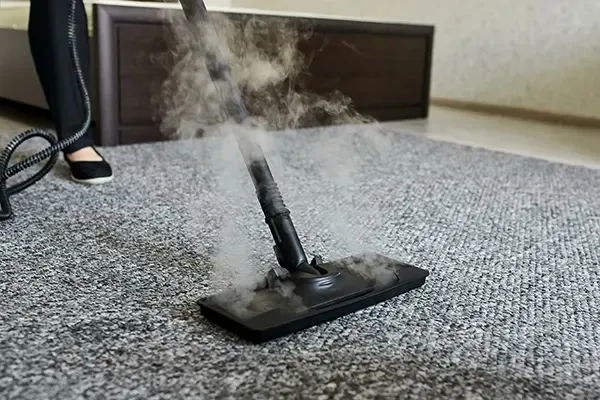
It depends on the fibre. A wool or synthetic rug can usually be cleaned with hot water extraction, the method most people call steam cleaning. Jute, sisal, seagrass, viscose and silk should not be: they need a low-moisture method. Our guide to steam versus low-moisture cleaning explains how the two methods differ.
Common Rug Problems
Fringes
Fringes catch in vacuum brushes and turn grey before the rest of the rug. Vacuum across them with the brush off, and comb them straight with your fingers. Cotton fringes on a wool rug often discolour first, which is normal.
Curling corners
Turn the rug over and roll the corner gently the other way, or place something heavy on it overnight. Rug grippers under the corners stop it coming back.
Colours running
If colour appears on the cloth when you test a corner, stop and leave the rest of the rug dry. Colour that has run cannot easily be reversed at home, and more water makes it spread.
Smells
Musty smells usually mean the rug, or the floor under it, has been damp. Pet smells come from urine that has soaked into the base. Airing helps with the first; the second needs a deeper clean. Our guide on pet urine smell explains why.
When a Rug Needs a Professional
- The rug is large, heavy or fitted under furniture.
- It is wool, silk, viscose or a natural plant fibre.
- The colours run when you test a corner.
- Pet urine has soaked through to the back.
- It has not been cleaned for several years and looks dull all over.
How We Clean Rugs
Our team cleans most rugs where they are, in your home or office, so there is nothing to carry or collect. We check the fibre and the colours first, then use hot water extraction or our low-moisture method depending on what the rug can take. A rug of up to 6 m² costs £55, and larger rugs are priced by area. Rugs can be cleaned on the same visit as your carpets, as listed on our carpet cleaning London page. If you have upholstery that needs attention too, our guide to cleaning a fabric sofa is a good place to start.
Rug Cleaning Questions
Can I put a rug in the washing machine?
Only if the label says it is machine washable, which is usually the case for small cotton and some synthetic rugs. Use a cool, gentle cycle and mild detergent, and dry it flat. Wool, jute, sisal, viscose and silk rugs should not go in the machine.
How do I dry a rug after cleaning it?
Lay it flat or hang it evenly, with air moving on both sides, and turn it over halfway. Keep it out of strong direct sun, which can fade the colours, and make sure it is completely dry before you put it back on the floor.
Why has my jute rug gone brown after it got wet?
Jute and other plant fibres contain natural compounds that rise to the surface as the fibre dries, leaving brown marks. This is called browning. The best prevention is to blot spills quickly and use as little water as possible.
How often should a rug be professionally cleaned?
Once a year suits most rugs. A rug in a hallway, under a dining table or in a home with pets or young children stays fresher with a clean every six months.
Is a rug cleaned the same way as a fitted carpet?
Not always. A wool or synthetic rug can be cleaned like a carpet, but many rugs are made of fibres that need a low-moisture method, and fringes and edges need extra care. We check each rug before choosing how to clean it.
Keep Your Floors Looking Fresh
- Steam or low-moisture cleaning and which fibres suit each one.
- How to get stains out of carpet: most of the methods also suit rugs.
- How to get mould out of carpet when a rug has been left damp.
- Rug and carpet cleaning in London including our work in Chelsea.
Have a Rug That Needs More Than a Vacuum?
Send us a photo of the rug, its size and, if you have it, the label on WhatsApp, or share the details through our contact form. We will tell you how we would clean it and send you a quote.